

What Is Governance and Why Should Allied Health Providers Care?
Governance sounds like something only big providers worry about. What it actually means, why regulators are enforcing it now and where to start.
Resources
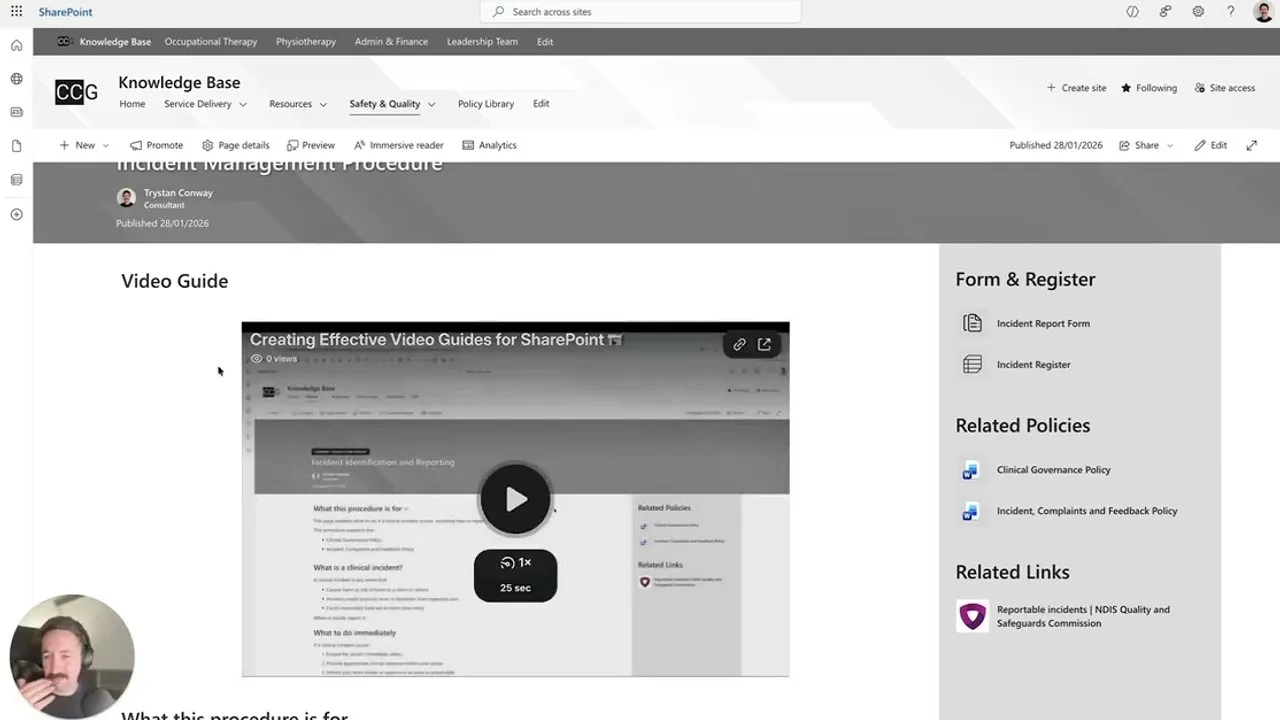
Governance works when your policies, procedures and registers live in one place your team uses every day. This walkthrough shows how to build that place in SharePoint, one area at a time.
Runs 12 minutes. Using Google Workspace instead of Microsoft 365? The same principles apply, and I also build knowledge bases on Google Sites.
Governance keeps people safe. It also decides whether your business is ready for a regulator now looking at unregistered providers.
The NDIS Commission has named strengthened oversight of unregistered providers a current regulatory priority. Mandatory registration expanded in July 2026 to Supported Independent Living and digital platform providers, not to Allied Health.
The NDIS Amendment (Integrity and Safeguarding) Act 2026 commenced in April 2026. A serious contravention now carries a maximum civil penalty of $16.5 million for a body corporate.
The Aged Care Act 2024 commenced on 1 November 2025. It places strengthened obligations on associated providers, the Allied Health providers a registered provider engages to deliver its services.
Governance sounds like something only big providers worry about. What it actually means, why regulators are enforcing it now and where to start.
Governance is built one area at a time. Trying to do all of it at once is how it ends up as a folder of policies nobody reads.
How many locations are your policies, procedures, forms and registers spread across? How many are current?
Safety and quality is usually the best starting point, because it has the most regulatory exposure. Get your incident management procedure, form, register and policy into one place, then replicate that pattern across everything else.
Policies set expectations and procedures explain how the work is done here. Combined, they make documents too long for anyone to use.
Book a discovery call if you want governance your team uses in practice. I work with Allied Health providers across Australia on governance frameworks, knowledge base builds and operational systems.